
The Shattered Chessboard
Anatomy of an Attempted Strategic Decapitation of the Mollarchy

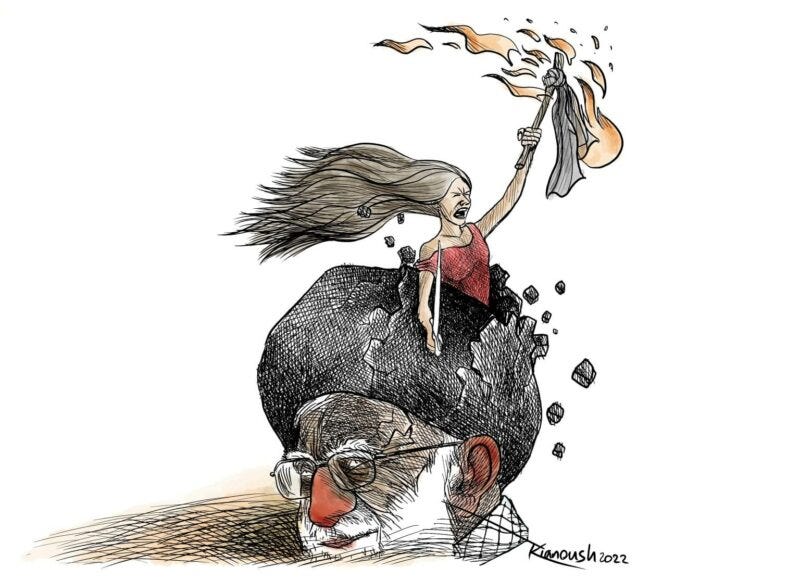
What opened this morning is not a mere sequence of strikes: it is a rupture experiment—an operation that seeks not only to destroy capabilities, but to unhinge a vertical order; to make an inner certainty wobble: the certainty that, at the very top, one can still convene, decide, and believe oneself protected. For years, Iran sold the image of strategic depth—regional networks, missiles, the sanctuarisation of power. February 28 reverses the perspective: the shockwave does not come only from the explosions, but from the doubt they inject—doubt about security, about loyalty, about the very continuity of the theocratic state.
Twenty-four hours ago, this conflict involved seven nations. At this hour, there are at least eleven. By Monday, there will be more.
On the morning of February 28, 2026—broad daylight, a rare departure in the history of Israeli operations against Iran—Israel and the United States launched a joint operation dubbed Operation Epic Fury on the American side, Roaring Lion on the Israeli side. Strikes were reported across several provinces, including Tehran, Isfahan, Qom, Karaj, Kermanshah, Tabriz, and Lorestan. Dozens of military, ballistic, and command sites were hit, and according to an Israeli official cited by Reuters, the primary target was neither a reactor, nor a silo, nor a missile bunker. The target was the political and security apex—more precisely, the meeting of the Supreme National Security Council, where, at that very moment, Supreme Leader Ali Khamenei, President Masoud Pezeshkian, and the country’s highest military officials were said to be seated.
Reuters reports that Khamenei and Pezeshkian were targeted, with no public confirmation yet of the outcome. Khamenei’s compound sustained significant damage; and Israeli media have floated—without independent proof—the hypothesis of his death. Iran’s foreign minister stated that, to his knowledge, “the ayatollah was still alive.” No verifiable proof of life was released immediately, and Reuters indicates that Khamenei was moved to a secure location. Simultaneously, Reuters reports—citing three sources—the presumed deaths of Brigadier General Aziz Nasirzadeh, Iran’s defence minister, and General Mohammad Pakpour, commander of the Islamic Revolutionary Guard Corps (IRGC). This tally adds to the June 2025 sequence, when Reuters attributed to Israeli strikes the deaths of several senior commanders (including Salami, Bagheri, Hajizadeh, and Rashid) as well as leading nuclear scientists. The IRGC is now an apparatus whose summit has been struck repeatedly in less than nine months.
The Architecture of a Strike
The entire operation of February 28 rests on a premise that only exceptional intelligence could render operational: identifying, within a given window, a rare vulnerability at the very top. The American military build-up in the region had been reported, and the Israel–United States coordination is described as long prepared. It was an architecture designed to strike the head first, and the rest afterwards.
Every previous Israeli strike against Iran—October 2024, June 2025—had been launched at night. Today, Israel struck in broad daylight because intelligence dictated the hour, not the other way around. By subordinating operational timing to the enemy’s calendar rather than its own, the IDF inverted conventional logic: it is no longer the attacker who selects the comfort window; it is the target that, unknowingly, designates the instant of its own vulnerability. The Iranian regime—what remains of it—knows three things: Israel knew the political target; Israel knew the window; Israel knew the list of participants. And if Khamenei was evacuated before impact, a fourth certainty follows: the protection of the summit was pierced (a leak, a compromise, or a structural breach), and someone within the innermost circle informed Jerusalem. If, on the contrary, he was still in the building at the moment of impact, then the entirety of the Leader’s personal security apparatus stands indicted. In both cases, the quake is existential.
The Iranian Riposte: Range Without Accuracy, Fury Without Coalition
Iran responded with salvos of ballistic missiles against American installations and regional partners within reach: sites and military zones across the Gulf, including Bahrain, Qatar, and Kuwait, according to Reuters. Several states reported interceptions. In Abu Dhabi, a civilian was killed by interception debris; in Dubai, the crisis disrupted one of the densest airspaces on earth, with interceptions and alerts. For the first time, Gulf air-defence systems were activated almost simultaneously. Most interceptions succeeded. Iran demonstrated range. It did not demonstrate accuracy.
Hubs suspended or reduced operations and hundreds of flights were cancelled or diverted, according to Reuters and other agencies. Emirates, Etihad, Qatar Airways, Turkish Airlines, Air India, Lufthansa, British Airways: everything grounded or rerouted. The economic impact of this disruption, in a hub that structures a major share of global transit, far exceeds the immediate military balance sheet of Iran’s strikes themselves.
By firing on six countries at once, Tehran achieved what Israeli and American diplomacy had been trying for years to secure without fully succeeding: forging a de facto solidarity between the Gulf monarchies and the Washington–Jerusalem axis. The coalition that did not exist yesterday exists today—not because a treaty created it, but because Iranian missiles crossed the skies of Bahrain, Qatar, Kuwait, the Emirates, Jordan, and Saudi Arabia.
Diplomatic Dominoes: When Allies Fall Silent and Neighbours Turn
The Saudi reversal is the most spectacular geopolitical fact of this sequence. On January 27, 2026—exactly one month before the strikes—Crown Prince Mohammed bin Salman personally assured President Pezeshkian that the kingdom “would not allow its airspace or territory to be used for any military action against Iran.” Riyadh then professed respect for Iranian sovereignty and support for dialogue. A month later, Saudi Arabia issues a statement of an entirely different tone: it condemns and denounces, with the utmost firmness, Iran’s brutal aggression against the Emirates, Bahrain, Qatar, Kuwait, and Jordan, and it displays regional solidarity. In thirty days, Riyadh moves from neutral mediator to a pillar of collective response against Tehran. It is Iran itself—by striking the neighbours Riyadh had pledged to protect—that has destroyed the Saudi–Iranian modus vivendi that China had patiently constructed since March 2023.
Russia has been linked to a discreet agreement on Verba MANPADS, revealed by the press and relayed by Reuters, with no public proof of immediate delivery to Iran. Beijing was discussing the sale of CM-302 anti-ship missiles for the IRGC’s naval arm. Joint Russia–China–Iran naval drills had transited the Strait of Hormuz shortly before the strikes. And yet, when the bombs fell on Tehran, Moscow issued a statement calling the strikes an “unprovoked armed aggression.” Beijing denounced an “extremely dangerous hegemonic bullying.” Then both powers remained motionless. Not a ship, not an aircraft, not a soldier moved.
Iran needed deeds. It received press communiqués.
This passivity exposes a structural truth: the Tehran–Moscow–Beijing axis functions as a lever to erode the Western order, but does not behave as a defence pact. For the Iranian regime, discovering that one is alone under fire at the decisive moment is a strategic shock whose consequences reach beyond material losses.
The European Union, France, Germany, and the United Kingdom reacted with a blend of alarm and calibrated caution. Macron called the escalation “dangerous for everyone” and requested an “urgent” meeting of the Security Council. The Paris–Berlin–London trilateral statement “condemns in the strongest terms the Iranian attacks,” while specifying that the three countries “did not participate” in the strikes. Von der Leyen calls for “maximum restraint.” But this posture of moral overhang barely conceals a harsher reality: for years, Europe bet on a nuclear dialogue with Tehran—the JCPOA, then its successors—while refusing to designate the Revolutionary Guards as a terrorist organisation until very recently. On February 19, the EU crossed that threshold. It also bet on keeping channels open with a regime it knew was massively repressing its own population—an extremely heavy toll in the protests since December 2025, according to some estimates. Europe believed it could play on two boards at once: rhetorical firmness and diplomatic commerce. On February 28, both boards collapsed at the same time. Europe is neither in the striking coalition, nor in effective mediation, nor in the protection of its own energy interests. It is a spectator—and it knows it.
The Iranian Opposition: The Window and the Precipice
A few days before the strikes, Reza Pahlavi, son of the last Shah, gave Le Point an interview detailing his hundred-day roadmap for a post-theocratic transition: immediate monetary stabilisation, a constituent assembly, a referendum to choose the form of government. As early as January, he declared in Washington that “the Islamic Republic will fall—it is not a question of if, but when,” calling for surgical strikes against the Guards. In February, he urged the international community toward a humanitarian intervention aimed at breaking the repressive apparatus. The February 28 strikes realise, in their military dimension, part of the scenario Pahlavi had advocated. But the central question remains intact: can a fragmented opposition—exiled, polarising even within the diaspora, where Pahlavi is accused of authoritarian tendencies and excessive proximity to Israel—capitalise on a moment of chaos engineered by others? Protesters who had filled the streets since December 2025, waving the imperial flag and chanting “Javid Shah!”, now find themselves between two fires: the repression of a regime in extremis and the bombs of a foreign coalition.
Benjamin Netanyahu explicitly framed the operation’s political objective: calling on Iranians to free themselves from the regime. This discourse extends the one he delivered in June 2025 in Beersheba, amid the ruins of Soroka Hospital struck by an Iranian missile, where Netanyahu said the time had come for Jews to “repay their ancient debt to Cyrus the Great and bring liberation to Iran.”
The True Centre of Gravity
The Israeli operation does not target Iran’s capacity to harm—it targets its capacity to believe itself invulnerable. By demonstrating a total intelligence penetration into the very heart of the Supreme National Security Council, Israel attacks the bond of trust that holds together the Leader, the IRGC, the clerical establishment, the security technocracy, and the services. Every general who sits tomorrow before Khamenei—if he is still alive—will suspect his neighbour of having informed Jerusalem. Every IRGC commander summoned to a meeting will wonder whether the invitation is a duty or a death sentence. Every “secure” site in Tehran now appears vulnerable. In June 2025, Israel had struck thirty generals in minutes: a brutal rain of fire on dispersed targets. On February 28, 2026, the logic is implacable: decapitate the regime. A single instant. A single room. Months of patience. A result that far surpasses the material tally: the methodical destruction of the very possibility of a “trusted” meeting at the summit of power.
The Iranian regime—the one that survived the June 2025 war, the bloody repression of tens of thousands of demonstrators, economic collapse, and the rial’s plunge—now finds itself burdened with a double deficit: a material deficit, with the presumed loss of the defence minister, the decimation of the high command, and the total confusion of the decision chain; and a symbolic deficit, with the weakening—or possible disappearance—of the Leader’s figure, the hinge between ideology, security apparatus, and institutions. Without a visible Khamenei, the regime loses its source of theocratic legitimacy. With a wounded or diminished Khamenei, it enters a succession crisis under fire.
Cyrus, the Debt, and the Inverted Chessboard
During the Gaza war, visiting troops and the wounded, Benjamin Netanyahu warned that this war would not end in the ruins of Khan Younis or Rafah, but in Tehran. In Beersheba, in June 2025, before Soroka Hospital, he invoked the figure of Cyrus the Great—the Persian sovereign who freed the Jews from Babylonian captivity 2,500 years ago—to declare that the time had come to “repay the debt.” The families bereaved on October 7, the survivors of Iranian missiles, the survivors of the regime’s post-protest repression: for them, Netanyahu’s promise was not rhetoric, but a blood oath.
Today, that promise takes shape. Netanyahu addresses the Iranian people and tells them: “Here is your chance to build a new and free Iran.” What is at stake exceeds the frame of a military operation. It is an inversion of historical symbolism: it is no longer Jerusalem at the mercy of Persia’s will, but Persia’s leadership discovering it can be reached—without warning—at the very centre of its power. Israel, in its own eyes, “repays its debt to Cyrus” by closing a millennial cycle: it offers Iran the possibility of liberation, as Cyrus once offered the Jews the possibility of return.
At bottom, what is emerging no longer follows the classic strike/retaliation cycle. It is a chess game played on multiple boards at once. Israel has advanced a piece the regime did not believe possible: not another bombardment of infrastructure, but a direct offensive against the power’s very ability to convene, decide, and trust. The ayatollah, the generals, the IRGC strategists no longer know whether they are players—or already-targeted pieces.
This is not a battle. It is a strategic check rendered irreversible from the first move.
The Mullah Totters, the Game Continues
The game is not over. The fog of information has become a dimension of war: the Leader’s true status, the depth of losses, the ability to reconstitute a functioning command chain, the risk of purges and internal paralysis. Outside Iran, the conflict may still spread: peripheral fronts, allied militias, and the transformation of a de facto Gulf coalition into a de jure coalition.
On the board, the Iranian regime totters, but it has not been officially overthrown. The opposing coalition advances its pieces, but it plays on the lip of a precipice where a miscalculation could turn check into general conflagration. Multiple states are now caught in this game. Each new launch, each strike, each rumour about the fate of the Leader and his generals becomes another move in a match whose end no one can yet name: a silent checkmate, an uncontrolled explosion, or a new balance of terror redrawn in the shadow of that morning when, for the first time, Tehran discovered what it means to be the central square of the chessboard—and Jerusalem reminded the world that debts, even those twenty-five centuries old, are always honoured in the end.