
Decline is a Choice
On the defacement and the restoration of a Washington monument, and the small, unwitnessed decisions by which a civilization consents to live — or to die.

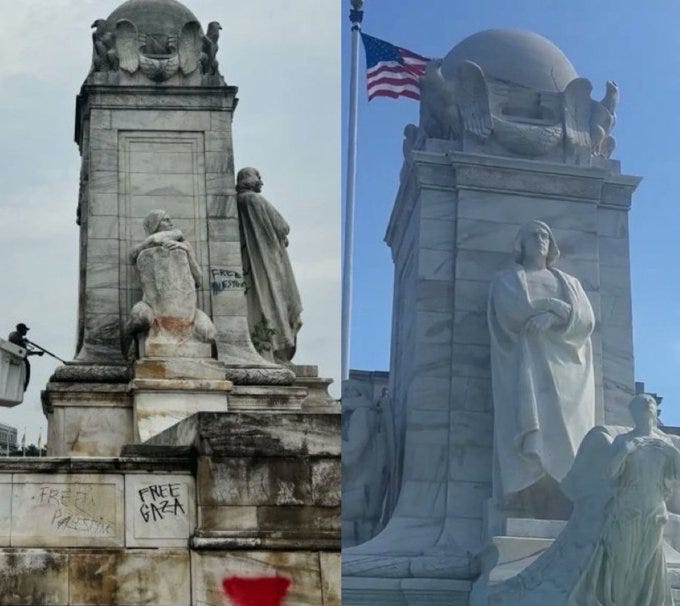
THE DIPTYCH. The Columbus Memorial Fountain at Union Station, Washington. Left: defaced and under cleaning after the protests of July 2024. Right: restored, the flag returned to its pole.
Two photographs of the same stone. In the first, the marble is grey with grime and bruised with paint; across its base, in a hand that does not bother to be legible, two phrases — Free Palestine, Free Gaza — and a single red smear, like a wound left open on purpose. A workman leans from the basket of a lift, a pole extended toward Columbus as though to wake him. In the second photograph the stone is white again, the flag is back on its pole, and Discovery, the winged figure at the prow, leans once more into a wind that blows only forward.
The pair is usually offered as a sequence — before and after, defilement and repair, the soothing grammar of a problem that resolves itself. It is nothing of the kind. These are two conditions a society may inhabit, and the only thing standing between them is a man who decided to climb into the basket.
Lorado Taft set this fountain before Union Station in 1912, in the high noon of a republic that still believed in its own founding. Columbus stands fifteen feet of marble on the prow of the Santa María, arms folded, facing the Capitol. To one side, the bearded patriarch of the Old World, turned east toward the continent left behind; to the other, the kneeling figure of the New World, turned west toward the one discovered. Above them a globe of the Western Hemisphere, lifted by four eagles. On the back, the sentence the age could write without irony: that his faith and his courage gave to mankind a new world. Whatever one now makes of the man, the stone was never modest. It was a promise a state made to its own past.
In July 2024, while an Israeli prime minister addressed a joint session of Congress half a mile away, a crowd took the plaza. They pulled the American flags from the three poles — the poles that stand for the Niña, the Pinta, the Santa María — set them alight, and ran up the flag of a territory five centuries and an ocean removed from anything Columbus ever touched. Then they went at the marble. Free Gaza. Hamas is coming. On the replica Liberty Bell across the plaza, in larger letters: Abolish the USA. And beside the slogans, the inverted red triangle — the small geometric sign that, in the militia’s own footage, marks a thing an instant before it is destroyed.
What does a Genoese navigator, five centuries dead, have to do with Gaza? Nothing. That is the point, and to miss it is the first concession.
The non-sequitur is not a failure of the gesture; it is the gesture. The grievance is portable, a solvent that takes the shape of whatever vessel it is poured into. Coherence was never the aim. The act is older than any of its slogans: to mark a surface that is not yours is to declare that nothing is anyone’s, that the sacred is a fiction and the fiction is now yours to spoil. Mary Douglas taught that dirt is only matter out of place. The iconoclast inverts her — he fouls the clean thing not to misplace it but to abolish the category of the clean altogether. The red triangle is not graffiti. It is liturgy: a borrowed sacrament of targeting, carried in from a distant war and pressed onto American stone because the war is everywhere now, and the stone was only ever a pretext.
Notice the figure they could not be bothered to spare. The New World — the Native, the colonized, the very allegory in whose name the modern penitent claims to act — was fouled as indiscriminately as Columbus himself. The spray does not read. It does not distinguish the conqueror from the image of the conquered. It marks. And to mark is to refuse the labor of meaning. The refusal of meaning is the whole of the program.
Why Columbus, and not some figure with an actual quarrel in the Levant? Because Columbus was already half-condemned. The statuary of the West had been softened across the long summer of 2020, when the same monuments went into the same harbors under a different banner. The ground was prepared. The cause rotates — race, then climate, then Gaza — but the object never changes: the symbol of a civilization still confident enough to commemorate itself, the stone that says a people once believed it was legitimate. The slogan is interchangeable because the slogan is not the point. The point is to cancel the yes a monument utters. Yes, we were here. Yes, we built this. Yes, it meant something.
A poison works slowly, transforms what it enters, wears the face of something harmless, and leaves no signature on the body. So does this. No single act of vandalism brings a republic down; the defacement, taken alone, is almost nothing. The defacement is not the danger. The danger is the morning the lift does not come.
But the lift came.
It is worth dwelling on how unglamorous the rescue was. Park Service conservators trained in marble, brushing on a solvent that goes by the indelicate trade name Elephant Snot to loosen the paint; treatment after treatment across several days; the power-wash; the patience. New flags raised by the Park Police, and again that night by members of Congress with their own hands. None of it automatic. Every gram of it willed. Someone stood before the grey, defiled stone and decided it would be white again — and then did the slow, unphotogenic work of making it so. That decision, municipal and almost invisible, is the entire distance between a civilization and its ruin.
Decline is a choice. The phrase is Charles Krauthammer’s, who meant it of American power abroad; it travels even better turned inward, toward the house a civilization keeps for itself. Nations are not felled by the vandal. Rome did not fall because a barbarian scrawled on a wall. A people falls when it comes to agree, quietly and without ever quite voting on it, that the wall was never worth defending — when the shrug takes the place of the lift. Decadence is not the graffiti. Decadence is the settled conviction that scrubbing it off is provincial, that the monument was guilty anyway, that the man in the basket is the one standing on the wrong side of history. The vandal, at least, believes in something. The decadent believes the man with the solvent is the problem.
A monument is a promise a state makes in two directions at once — to the dead, that they will be kept; to the unborn, that something will be standing when they arrive. The order that made such promises legible — a world of states that hold their ground, hold their symbols, hold their meaning — is thinning into one where every grievance belongs to everyone, where no border and no stone keeps its edges, where the targeting-mark of a faraway militia can be sprayed across the marble of a republic and called conscience. To restore the stone is not nostalgia. It is the refusal to let the promise lapse.
❧
So the diptych is not before and after. It is two futures, photographed on a single day, and the gap between them is exactly the width of one decision, taken by one person willing to be thought unfashionable.
The graffiti will return. It always returns. The question a civilization answers — not once, in a battle, but every morning, in a hundred small and unwitnessed acts — is whether the lift returns with it.
Someone has to want the stone to be white. That wanting is not weakness and it is not given; it is chosen, and it can be declined, and a people that declines it long enough will wake one morning to find the marble grey, the flag down, and no memory of having decided any of it.
Decline is a choice. So, too, are the basket, the solvent, and the slow climb toward the stone.
NOTE. The images document the Columbus Memorial Fountain at Union Station, defaced during the protests surrounding the Israeli prime minister’s address to Congress on 24 July 2024 — when American flags were torn down and burned and pro-Hamas slogans, including the inverted red triangle, were sprayed across the marble — and its subsequent restoration by the National Park Service. Federal charges followed for several of those identified.